

Start with the guide closest to your situation, then use Call Now when you are ready to talk to an independent provider covering San Antonio.
Start with the question you have
Each guide is written to answer one question completely. Pick the one that matches what you are asking right now.
| Guide | Read it when |
|---|---|
| Signs and inspection: damage restoration | you smell mustiness or see stains |
| Comparing damage restoration quotes | comparing damage restoration quotes |
Household pest cheat sheet
| Pest | What it looks like | Typical sign | Where to look |
|---|---|---|---|
| American cockroach | Reddish-brown, up to two inches, yellow edge on the head | Single large roaches at night | Drains, garages, mulch, crawl spaces |
| Subterranean termite | Small, pale workers; winged swarmers in spring | Mud tubes, discarded wings | Foundation, crawl space, wood touching soil |
| German cockroach | Light brown, two dark stripes behind the head, about half an inch | Droppings like pepper, egg cases, musty odor | Behind appliances, under sinks, in cabinet hinges |
| Carpenter ant | Large, black or red and black | Coarse sawdust-like frass near wood | Damp wood, window frames, decks |
| Bed bug | Reddish-brown, flat, apple-seed size | Rust spots, shed skins on mattress seams | Mattress, headboard, bed frame |
| Mosquito | Slender, long legs, whining flight | Bites at dawn, dusk or daytime | Standing water, shaded vegetation |
| Brown recluse and black widow | Violin mark and six eyes; shiny black with red hourglass | Irregular webs in storage and woodpiles | Garages, boxes, undisturbed corners |
| Odorous house ant | Small, dark brown, coconut smell when crushed | Trails along counters and walls | Kitchens, bathrooms, wall voids |
Pest control terms explained
- Exclusion: sealing gaps, installing sweeps and screening vents so pests cannot enter
- Bait: a slow-acting food-based product that insects carry back to the nest
- Monitoring: glue boards, traps and inspection logs that show whether the plan is working
- Residual perimeter treatment: a product applied around the foundation and entries that keeps working for weeks
- Tamper-resistant bait station: a locked box that holds bait out of reach of children and pets
- EPA-registered label: the legal instructions for where and how a product may be used
- Integrated pest management (IPM): inspect, identify, fix the cause, then use the least risky effective product
- Insect growth regulator (IGR): a product that stops young insects from becoming breeding adults
Myths and facts
- Myth: spraying the ants you see ends the problem. Fact: baits that reach the nest work better and sprays can scatter a colony.
- Myth: natural means harmless. Fact: any pesticide, natural or not, should be used as the label directs.
- Myth: one treatment solves everything. Fact: many pests need a follow-up visit and fixes to entry points.
- Myth: a clean house cannot get pests. Fact: pests follow food, water and shelter, and even tidy homes can have them.
- Myth: pests only appear in summer. Fact: rodents, roaches and spiders stay active indoors in winter.
How damage restoration works from the first call to dry standard
Moisture sets the pace in restoration, and the first hours decide how much material can be saved. That is why the work runs in a fixed order, with every step documented.
- Safety first: stop the water, turn off power to wet areas and check for structural, electrical and slip hazards.
- Assessment: identify the source, the water category and the class of the loss, and map moisture with meters and thermal imaging.
- Extraction: remove standing water with pumps and extractors before anything else.
- Removal: take out materials that cannot be dried or are contaminated, such as wet carpet pad, insulation and drywall below the water line.
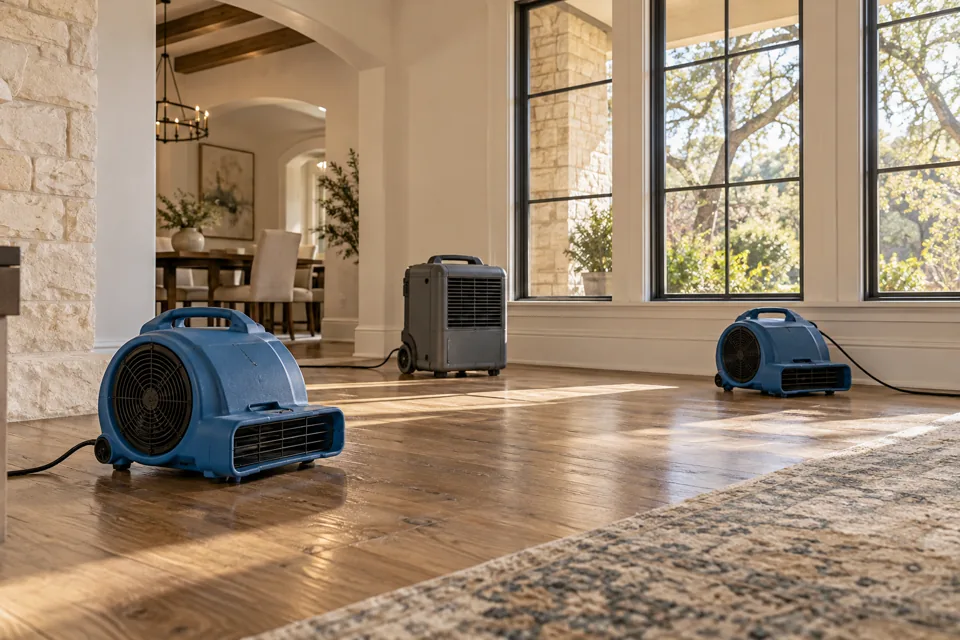
- Drying: place air movers and dehumidifiers and check moisture readings daily until the materials meet the dry standard.
- Cleaning and sanitizing: treat affected surfaces and contents, and deodorize if needed.
- Documentation and next steps: a record of readings and photos for the insurer, then repairs once everything is dry.
What shapes the written scope
No two losses are the same. A written scope should say what was found and which of these factors applied, so that estimates can be compared fairly.
- The class of the loss, which depends on how much material is wet and how fast it will dry
- The source of the water and how long materials stayed wet
- The water category: clean, gray or contaminated
- Access, the number of rooms and levels, and any contents that need to be moved or cleaned
- Whether mitigation only or repairs and rebuild are included
Safety, contamination and the standards
For water damage restoration, the industry reference is the IICRC S500 standard, setting out water categories, loss classes and drying goals. A clean supply-line leak turns more contaminated as time passes, and sewage or flood water counts as contaminated from the start.
Do not touch electrical equipment while standing in water, and do not use household vacuums on water. If there is sewage, a gas smell or structural movement, leave and call for help. Wear gloves and boots in affected areas and keep children and pets out.
What makes damage restoration different in San Antonio
San Antonio is a large Texas city with limestone soils, many slab foundations and a climate of hot summers and sudden heavy storms. Flash floods can follow intense rain on the Edwards Plateau and fill low-lying streets and homes quickly.
Hailstorms damage roofs, and the resulting leaks wet attics and ceilings. Slab leaks, water heater failures and AC condensate drains are common causes of interior water damage in homes. Ask the provider how these local conditions change how fast materials dry and what you should expect at your address.
Damage restoration across San Antonio and nearby cities
The area covered by Damage Restoration San Antonio is San Antonio, Texas and its surroundings, among them Alamo Heights, Schertz, New Braunfels, Boerne and Helotes. Each call and request is confirmed by address.
At the top of the page, Call Now lets you say what happened and when. An independent restoration company then confirms your address, assesses the damage and puts the scope in writing.